
This is the eighth in a series of essays (and the companion piece to the Mirror University 7) that reflect on the educational and organisational challenges facing universities as they navigate intersecting existential, epistemic crossroads. I have called the series ‘The Mirror University’ for several reasons. The Mirror Universe is an alternate reality from the cultural phenomena that is Star Trek, in which people who exist in the prime universe have ‘evil’ alternates in the mirror universe. These alternates maintain the structures, relationships, roles and even identities of the ‘prime’ characters but exhibit traits, morals and behaviours that are the antithesis of the higher moral ground taken by our heroes. The mirror university maintains the structures, organisation, practices, and mythologies of what we understand to be a higher education institution but behaves in ways that are the antithesis of the ways of being they aspire to.
The mirror university is a construct.
It doesn’t represent any single institution.
It is not an allegory for the overarching influence of ‘management’.
The aspirational contradictions create a sense of emotional and idealistic liminality for those whose personal, intellectual, or professional identity is deeply rooted in the altruistic conceptions of university as a site of transformational social good for the community, our students, and the academy itself.
TLDR version:
This essay argues that trust is the only currency that matters in higher education, and rebuilding it requires moving from a polarised, deficit mindset to a University of Trust, a living ecology of actions, behaviours, strategies, care and safety. Drawing on Humboldt’s living tension between Bildung (self-cultivation) and Wissenschaft (truth-seeking), it contends that the university’s soul emerges when paradoxes or ‘living tensions’ (such as academic freedom with accountability, collegial autonomy with managerial control, public mission with market logics) are navigated transparently and ethically. When trust frays, psychological safety collapses, innovation shrinks, and identities fragment; when trust is cultivated, the institution can walk and chew gum, aligning transactional and transformational logics without sacrificing integrity.
AI is not the root cause of distrust, but moral panic, surveillance cultures and policy overreach have supercharged polarisation, framing students as cheats and staff as obsolete, and displacing collegiality with compliance. The essay proposes five lived actions (collective mission, culture of care, controlled risk, civic engagement, and collegiality) as practical levers to rebuild the university of trust:
- Collective mission: A collaboratively formed academic mantra. A common direction, not a common directive that transcends silos and restores shared purpose.
- Culture of care: Turning care from goodwill into operational logic and predictable, humane treatment; transparent authorship, fair workloads, supportive supervision, so people experience the institution as reliable and ethically grounded.
- Controlled risk: Structured freedom for experimentation, dissent and intellectual courage, with clear boundaries and visible safeguards.
- Civic engagement: Dialogic relationships that lower social risk, demonstrate responsiveness, and align university and community through reciprocal accountability.
- Collegiality: A catalysing principle of reciprocity, respect and intellectual solidarity, turning differences into productive intersections and shared responsibility.
If we broke it, we buy it: by embracing the university’s creative, collaborative, conflicting, confounding and productive tensions, we rebuild trust, not as slogan or manifesto, but as a visible manifestation of the soul of the institution in teaching, research and engagement.
Introduction
In the seventh essay of the Mirror University series called ‘Trust is the only currency that matters in higher education: Rebuilding a culture of trust in an era of distrust’, I argued that the decay of trust in higher education represents the most fundamental crisis faced by the sector and that rebuilding trust is our most critical mission. Whilst universities have faced concurrent storms of crisis over the past two decades, and continue to experience the structural, financial and psychological angst after each crisis subsides, the decline of trust in institutions is an existential threat.
Since 2023, generative AI has thrown a sharp, exposing light on the decline of trust in universities. But it is not the root cause of it. As I argued in that essay:
…AI, its use cases and polarised usage debates are not to blame for the issues of trust we face. But we are all responsible for rebuilding it. We are responsible for the cultures we enable, creating differential value for trust in teaching and research. We are responsible for finding, amplifying and celebrating the voices of those who have benefited from trusting higher education, not punished for it. Trust is not a marketing slogan; trust is the fuel of human relationships.
That said, AI has made the recreating of a culture of trust in higher education challenging and the rationale for doing so opaque. The responses and reactions to generative AI within the sector have supercharged polarised cultures of acceptance, denial and moral panic (Borkowska & Jackson, 2026). Trust becomes the victim of a war of words and power over AI and what it promises to do (Dai et al., 2025). Polarised rhetorics about AI frame students as cheats and staff as obsolete, eroding confidence and trust in the systems of higher education (Cotton et al., 2024 and Buele et al., 2025). Fear-based narratives from all poles of the argument are dispersed into social media and through university governance structures. This amplifies surveillance rhetorics, compliance and productivity cultures and policy overreach, which undermines collegiality and staff/student happiness and satisfaction (Gruenhagen et al., 2024 and Lund et al., 2025). As Pillar (2025) writes in his white paper entitled ‘Rewiring the Academy: Leading with Hope in an Age of Chaos’, the impacts of an erosion of trust are both emotional and psychological failures that impact directly on the lives of those who reside in the community of the university:
When trust erodes in systems, like higher education, that require shared responsibility, they begin to fray from the inside….leaders who don’t acknowledge this risk missing the deeper impact of broken governance: disengagement, burnout, and a culture that mistakes formality for real contribution. This can make change, any change, near impossible.
To ensure our future, universities must live and breathe a culture of trust. Rebuilding trust in higher education is everyone’s responsibility, so this vision will not be framed by polemics about division: management versus staff, academics versus professionals to strategic versus operational. Trust in higher education is not a zero-sum game either. Trust multiplies rather than transfers. When one group gains trust, it does not require another to lose it. Instead, shared transparency, care and accountability expand the overall relational capacity of the institution, strengthening the entire academic ecosystem simultaneously. Trust already flourishes in higher education. Of course, students trust in the importance of a university education, but the evidence argues that trust is decaying. Of course, research changes lives and our society trusts in the results, but successive crises of retraction, fraud and AI misuse are fracturing trust in our expertise.
What I want to share is a positive, implementable vision for a University of Trust.
The University of Trust is built and nurtured by leaders of all stripes, from institutional through faculty through program through to teams and yourself, as a student, a staff member, an alumnus. The University of Trust rebuilds trust not as a monotheistic concept, but a living ecology of actions, behaviours, strategies, care and safety, located within the realities of the operating a university in a modern economy. Rebuilding trust is not a Pollyanna state. It is not a privileging of the transformational over the transactional university. We can walk and chew gum at the same time.
Bunnings is the most trusted brand in Australia (like B&Q for my UK friends and Home Depot for the US). It is trusted by the community because it can be both a major supporter of charities, community sport and civic engagement whilst at the same time being owned by one of Australia’s largest retail conglomerates. Walk. Chew gum. Sizzle sausages
The academy of trust creates an engine for authentic, real change that makes a difference to people, to communities, to societies, building trust with all our stakeholders, not as a promise or manifesto, but a visible manifestation of the soul of the institution made real through teaching, research and engagement. Over the course of this essay, I will address the philosophical and institutional foundations of the University of Trust, to deliver not a series of words from the sideline, but an ambitious, realisable map to rebuilding trust in our universities. But before we can get there, we need to reflect on the cadence of how universities go about their business.
Defining the soul of the University of Trust – Living Tensions
The cadence of a university’s operating models (funding cycles, regulatory rhythms, enrolment patterns, ideological angst and performance reporting) set the tempo for the prioritisation of activities, shaping what is resourced, protected, and possible. When that cadence harmonises with the institution’s soul (its scholarly purpose and civic ethos), it channels resources to the priorities, departments and programs aligned to that higher order of ambition. In theory.
What constitutes the soul of a university is a deeply philosophical but highly personal ontological construct. In other words, it complex and contested. In German philosophy (specifically the thinking of Wilhelm von Humboldt in the early 19th Century), the ‘soul’ of a university emerges through the living tension between Bildung and Wissenschaft, words without clear, translatable meaning in English. For the purposes of simplicity, I will start with the idea of Bildung as an inner-looking process of the self-cultivation of autonomous, reflective individuals through transformative learning, where students develop intellectual maturity, ethical awareness, and self-formation beyond vocational outcomes and Wissenschaft is a more outwards face form of truth-seeking. It is the collective, disciplined pursuit of knowledge through rigorous, inquiry-driven research and scholarship, grounded in shared standards of truth, method, and academic freedom. (for more extended debates around these concepts, see the always reliable Ron Barnett, 2024 and Kergel, 2022 who argues the concepts from the perspective of a digitised university).
Humboldt’s argument goes that the university is a dynamic equilibrium between Bildung and Wissenschaft. He argued that genuine learning emerges only when students engage freely with inquiry (in modern senses research, curiosity, discovery), allowing personal self-cultivation to unfold through participation in the creation of knowledge. Humboldt argued that genuine scholarly research depends on maintaining a productive tension between Bildung and Wissenschaft, rather than collapsing one into the other. Wissenschaft provides the disciplined, truth-seeking inquiry essential for generating reliable knowledge, while Bildung ensures that this inquiry remains rooted in the intellectual self-cultivation of both the researcher and the student (Sjöström & Eilks, 2020). This tension is not a flaw but the university’s defining raison d’être. Bildung prevents Wissenschaft from becoming mechanical or purely utilitarian, while Wissenschaft anchors Bildung in rigorous, shared standards of truth. Together, they shape a community devoted to intellectual freedom, holistic development, and the open-ended pursuit of understanding (see this 1970 translation of Humboldt and the more recent analysis by Bongaerts, 2022).
Trust resides in the living tensions that define a university. Living tensions emerge from the paradoxical states of institutional organising activities such as academic freedom with accountability, collegial autonomy with managerial control, public mission with market logics. Like Bildung and Wissenschaft, living tensions are critical for the viable functioning of the university. Where they differ is that whilst the Humboldtian concepts present a dualistic relationship defining the soul of the university, the reality of a modern university is exponentially more complex. In countries like the US, Australia, Canada and the UK where the role of government in universities is essentially interventionalist, in varying ways, across funding, policy, ethical and ontological realms, the absolute authority of the academy to define its soul is arguable. The notion of living tensions represents the university as an ecology of complex, intersecting, often hierarchical ambitions, motivations, actions and people. In organisational scholarship (see Hannan & Freeman, 1977), describing an institution as an ecology foregrounds complexity, mutual influence, and non-linear interactions rather than simple, hierarchical cause-and-effect. It highlights that trust, culture, identity, power, and knowledge-making are emergent properties of the system.
Trust is then sustained when leaders lean into and navigate paradoxes transparently, demonstrating their capability, benevolence, and integrity. The culture of trust enables collective sensemaking that legitimises change without collapsing difference, maintaining authenticity and authority amid contestation and institutional complexity (Gioia & Thomas, 1996 and Metz, et al., 2024). Trust derisks the complexity without compromising the opportunities that arise from the living tensions within the institution. Trust also legitimises that the outputs of the system to those who are not immersed in the tensions. Trust means you don’t have to fully understand how the sausage is made, but you trust it was made well, reliably and with the highest quality standards in place.
Building the University of Trust seems pretty simple when you say it out loud, right?
To trust others is to acknowledge that we depend on them, and on what they do, without in any way curtailing their freedom to act responsibly toward us. There can be no freedom without trust, and no trust without freedom.
Tim Ingold, 2020
Moving from the Post-Transformative University to the University of Trust
In 2024, I published an essay called ‘The Post-Transformative University’ in which I argued for a third space university operating model that navigated the transactional operating model of the modern university (sometimes referred to as the managerial or neoliberal university) and the transformational operating model (or what might thought of as the good old days, the university that acts as a public good and site of lifelong transformation of students and society). A post-transformative university, as I framed it, was my attempt to move beyond the churn of polarised tension between the two operating models. I argued for a university operating model that learns to stabilise, refuse performative change, hold space for uncertainty, and rebuild meaning and knowledge-making on its own terms. Without knowing it (or naming it!), that essay defined the most critical of living tensions within the modern university ecology – the transformational culture, which is in constant tension with its corporatised, transactional culture. Writers like Graeme Turner (see his book Broken: Universities, Politics and the Public Good from 2025) argue that this tension is a fight for the soul of the university (although he argued strongly that ab interventionalist government stance was a serious plater in this fight). My case is that this overarching living tension between cultures is the soul of the university. The modern university is not a third space, it is an ecology of the living tensions that define it, and it’s that (un)comfortable coexistence that rebuilds the soul of the university, and its culture of trust.
The reality of the modern university is that both its transactional and transformational souls will continue to exist in an uneasy alliance. It is a good thing they coexist. It is also good that they are in tension. These two operating models are the Yin and Yang of the university. Each counterbalances the other, generating productive tensions that continually reshapes the mission. strategy and obligations of the university. This ecology is fundamental to the soul of the university, in part because higher education institutions are essentially pluralistic, with divergent goals, requiring ongoing negotiation and shared sensemaking to integrate competing expectations without collapsing them into a single logic. All glued together by trust.
Living tensions can be self-sustaining, creative and productive. The moment trust is broken or ceded then the tension spins out of control. Positions are reinforced and lines drawn in the sand. In organisational behaviour theory, when trust breaks down, employees curtail risk-taking in relationships, withholding voice, knowledge, and initiative, which depresses motivation, innovation, execution and learning (Mayer et al., 1995). Identity frays at the edges and then into the centre and staff decouple from the institution’s goals and engage in quitting behaviours. Psychological safety collapses (Edmonson, 1999), dissolving the shared learning norms that anchor a coherent and collective ‘we’, leading to fragmented identities and declining senses of belonging. Staff and students (in our case) reside within siloes, cliques or within constrained environments of work (research/study) processes.
In a university, when the living tensions collapse, the university drifts from the ideal of free, unforced collaboration, and unintended consequences such as mental health and the wellbeing crisis unfold impacting on the fabric of the community (see the Australian University Census on Staff Wellbeing 2025 and this article on the wellbeing of UK University staff by Rahman, M, et al., 2024). Humboldt warned that higher institutions must continually connect objective science and knowledge-making with subjective education; severing this link hollows the scholarly purpose of the institution. The soul of the university fragments. Staff experience mission drift, proceduralism, and diminished psychological safety, eroding trust. Students encounter transactional learning, weakened senses of belonging, and instrumental curricula eroding trust in their degrees and their learning experiences. Shared sensemaking collapses into compliance rituals. Communication cycles manage ambiguity and crisis without resolving it, fraying scholarly identity and purpose (the very things Humboldt argues sustain the living tension of a university).
How do we reside in the University of Trust?
There is an ecology to this university. Trust is not an equation, it is a system of causes and effects, pushes and pulls, which is why the tension between Bildung and Wissenschaft are so important to the fermenting of trust. It is also why the living tensions that define the university as it operates today cannot be ignored or allowed to spin out of control, marginalising one, polarising the other, and neither serving the needs of the ecosystem.
It is not like universities are starting at zero here. Trust hasn’t vanished overnight. But the decay is rapidly accelerating. And it is decaying from all angles of the community and in fraying in ways difficult to predict. Let me offer two current cases of how this unravelling trust is playing out, in real time.
The decay of trust #1
Students encounter transactional learning, weakened senses of belonging, and instrumental curricula eroding trust in their degrees and their learning experiences.
The COVID-19 pandemic disrupted the operating model of education around the world. Late in 2025, a significant number of UK students and their unions initiated legal cases against universities over the value-for-money proposition of remote learning during the pandemic. The momentum of these legal claims has intensified, with lawyers arguing universities breached consumer contracts by shifting paid in-person teaching to lower-value remote provision during the pandemic (see Weale, 2026). Following a major settlement with UCL, students, the UCU and their class-action lawyers expanded their action to 36 universities, with more than 170,000 students seeking compensation for disrupted teaching, closed facilities, and reduced learning experiences.
Countering that legal argument, there is significant and rigorous evidence that a) online learning is not cheaper than face-to-face (see Davis, 2025 amongst many others) and b) the alternative to remote learning during the pandemic was to furlough everyone and shut down for two years (see Bodon, 2020) (in fact, many universities were forced to shed thousands of staff across the sector, see Zhou, 2021). During lockdowns in Australia and the UK (and the rest of the world to differing degrees and times) there was no way we could have run on-campus provision in any semblance of normal ways. Remote learning was the only viable course of action. Moving assessment to online proctoring and invigilation was not optimal but it was the only compliant alternative, especially without the benefit of hindsight.
There is also significant and reliable evidence that the costs of higher education did not go down during the pandemic, and the subsequent years have been some of the most financially challenging of the sectors history (a crisis you might call it) (see this 2025 report from Universities Australia and this 2026 report from Universities UK). The pandemic crisis still be felt in universities. As Bryant, Lanclos and Phipps (2024) argue ‘crises rarely end with a clear resolution, or abruptly, and the effects can have varying degrees of impact for months and years later’. They describe this as the ‘long shadow’ of crisis, leading to what Berlant (2007) describes a ‘slow death’ from the physical and mental effects of crisis.
In this case, there is no trust between the institution, the staff who delivered remotely under extreme stress and some of the students who believe their tuition fees were excessive. From my experience, what was produced by universities during the pandemic was in the main high-quality education that graduated students of quality, that met and exceeded the standards required of the degrees they were awarded. It supported graduate employability ambitions and will have the lasting, resonant learning we hope for our students. Students and staff battled the unprecedented mental health, social isolation and social presence challenges (the slow death). But when trust is fractured, as I said earlier, tension spins out of control, positions are reinforced and lines drawn in the sand. And this is what underpins this legal action, tensions and consequences of those tensions spinning out of balance.
The decay of trust #2
Staff experience mission drift, proceduralism, and diminished psychological safety, eroding trust.
The Australian Government commissioned several significant reports into racism and gender-based violence on Australian university campuses in 2025 and 2026. The 2026 Australian Human Rights Commission report called ‘Respect@Uni: Study into Antisemitism, Islamophobia, racism and the experience of First Nations people’ revealed that racism in Australian universities is systemic and pervasive. Surveys of more than 76,000 students and staff showed that around 70% reported indirect racism and approximately 15% experienced direct interpersonal racism, with rates exceeding 90% amongst Jewish and Palestinian respondents and over 80% for First Nations, Chinese, Middle Eastern and Northeastern Asian groups. These findings highlighted deeply embedded structural and interpersonal racism across all institutions and low trust in the complaints systems of universities to resolve these issues fairly. Only 6 % of those who experienced direct racism formally complained to their university, with many citing fear of reprisals and low confidence in complaint systems as key reasons for non-reporting (Cassidy, 2026). In the UK, sector-wide reviews have found that many students and staff do not trust formal reporting processes for racial harassment, often avoiding formal complaints due to a perception that institutions do not take them seriously and lack effective accountability (Universities UK, 2024).
The Australian Government introduced the 2025 National Higher Education Code to Prevent and Respond to Gender-based Violence, mandating seven legally enforceable standards requiring universities to adopt whole-of-organisation, trauma-informed approaches to prevent and respond to gender-based violence. The 2021 National Student Safety Survey found 1 in 20 students had been sexually assaulted and 1 in 6 had been sexually harassed since starting university (the next survey is due this year). Women, people with disability and LGBTQ+ students were disproportionately impacted, and only 30% of student survivors were satisfied with institutional responses. Staff experience significant harm as well: evidence shows gender-based violence, including sexual harassment and workplace-related misconduct, continues at significant rates across higher education communities.
In this case there is no trust in the ecology of the university. Gender-based violence, racism and the undermining impacts of bullying and harassment that come with those behaviours continue to infect the culture of higher education, and in the words of Greg Pillar cited earlier, the results are ‘…disengagement, burnout, and a culture that mistakes formality for real contribution’.
Rebuilding the University of Trust
There are five lived actions that every member of the university community can engage as part of their daily and strategic activities to rebuild the culture of trust, internally and externally. The five lived actions are collective mission, culture of care, controlled risk, civic engagement and collegiality. The lived actions can only ferment and maintain trust in an environment of the critical living tensions that define our organisations as university. I have articulated four of these living tensions (Research/Teaching, Transactional/Transformational, Staff/Students and Bildung/Wissenschaft). In each institution, faculty, department, division or School, there will be more living tensions that define the soul of the university you reside in.
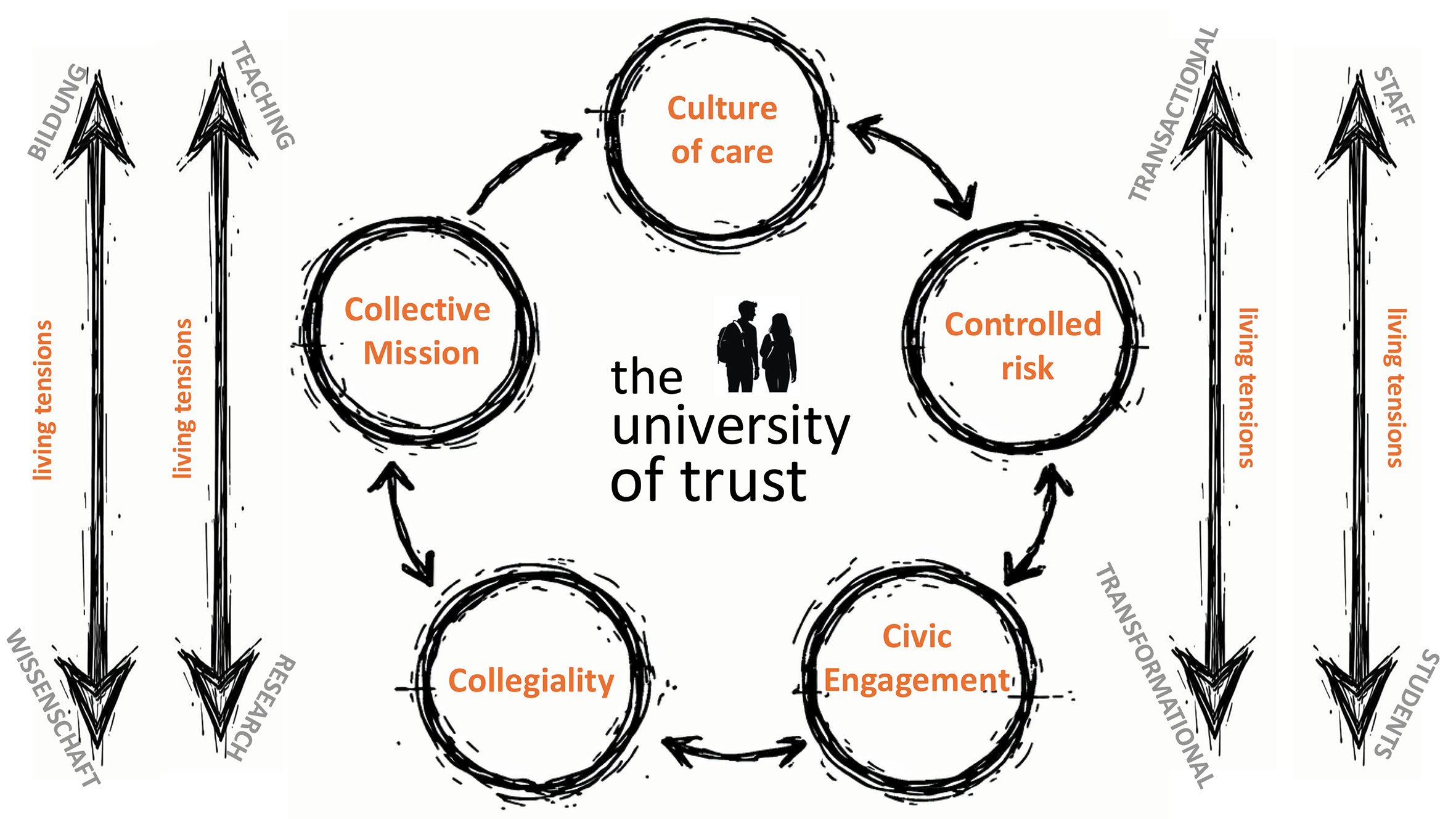
Collective Mission
To build a culture of trust, the collective mission of the university must be more than a strategic strapline, or an assertion of being good or transformative. The collective mission must be defined and owned by the whole institution and its communities. Real, impactful and authentic trust grows from the intellectual ecology that is dependent on a common direction not a common directive. A collective mission can be hard to promulgate, and in a complex, multi-faculty institution can seem like an impossibility to agree on, without a top-down directive. A collective mission is a unifying narrative that transcends boundaries and individual agendas and embraces the intentions of the positions and practices in living tension. Unlike corporate mission statements, a collaboratively formed academic mantra articulates common purpose, scholarly values and social responsibility (back to Humboldt). This shared meaning strengthens trust, nurtures psychological safety, and provides a coherent compass for decision-making, collegial behaviour and community wellbeing.
How can I make it happen? Don’t let words define the absence of action. That becomes inertia. A collective mission starts with you. What is your narrative for wanting to be part of a University of Trust? How does that collective narrative intersect with the people you work with, inside and outside? Do we collectively understand the collective mission of our students, or are industry partners, or our community? How do you find that out in ways that shape the space in between the missions to be inform the collective one?
Culture of care
It would seem self-evident that a culture of care is good thing, and when you feel cared for, trust usually follows. But as we have discussed throughout this essay, safety, responsibility and concern for people are not universal in universities. Trust cannot be mandated. It must be earned through consistent behaviours, supportive structures, and relational practices that demonstrate the institution, its people and its communities, care. When care is embedded in interactions and in leadership behaviours, it signals that the university can be depended upon to protect wellbeing, uphold dignity, and respond fairly to harm or vulnerability. Care becomes the operational logic that transforms trust from an individual sentiment into a collective institutional trait,
How can I make it happen? Pretty simple, really. Care. Care is a human trait. AI cannot care about you or your wellbeing, or the wellbeing of those around you. They can simulate care, but only humans care emotionally create a culture of care. Living tensions when they spin out of control create stress, enable reactive behaviours like lashing out and eventually defensive behaviours, curling up in a ball and letting the kicking happen until it stops. A culture of care recognises people are under these conditions and whilst you can’t solve every problem, a simple gesture of care can make a difference in the ways people trust. A culture of care extends not just to teaching and work practices, it is critical for research. It builds trust by embedding consistent, compassionate practices, such as transparent authorship and attribution, fair workloads, supportive supervision, human ethics and psychologically safe collaboration. When we experience predictable, humane treatment as researchers, we view the institution as reliable and ethically grounded, strengthening collective confidence and enabling deeper intellectual risk-taking and genuine collegiality.
Controlled risk
Risk is one the most perfect manifestations of the careful balance that exists in the ecology of living tension. For some, risk needs to be calculated, ranked, and mitigated. For others, principled practices such as academic freedom, research ethics and institutional governance and policy mitigate risk. Controlled risk represents the ways in which an institution and its staff can enable trust through collective responsibility, an informed criticality of how principles are enacted; not to defend all behaviour but to enable the behaviours that create the environment that promulgates impactful authentic societal change. Controlled risk builds trust in universities by creating environments where uncertainty is managed rather than avoided. When institutions set clear boundaries, provide safeguards, and transparently communicate how risks are anticipated and mitigated, they support the community to engage in challenging ideas, innovative research, and constructive dissent without fear of disproportionate consequences for anyone, no matter where they are in terms of the tension hierarchy.
How can I make it happen? Risk is one of the most personal yet abstracted from the personal concepts in higher education. We all have risk tolerances, but they are influenced to varying degrees by the risk appetite and formal risk processes of the institution. Risk is an interesting example where the living tensions are not so much complementary but interconnected. Individually, controlled risk is a confluence of consequence, confidence and communication. Our complexity makes knowing the knock-on effects of any decision impossible to predict. But step one in our trust university world is to know that every decision has a consequence and that you care about what happens to others because of things you do. I peer review an article. I decide to reject that article. It seems like there is little risk. Double blind reviews, yup, I can be reviewer #2. But controlled risk is only controlled when your actions are determined through the lens of consequences. A human will read your feedback. What would want to hear from a review? How would take a brutal review? It won’t change the decision if its right, but it will change how enact it, and most importantly how its received, hopefully with trust at the centre. Controlled risk is not about controlling risk to you.
Civic engagement
Sometimes, it is easy to be inwardly focused. An ecological system like a university hums along within the walls of the campus in a pretty much self-sustained manner during semester (at least). But our lovely little ecosystem has breaks in the circle like little glitches that expand outwards and into complex network diagrams of people, industry, government, alumni and families. Sometimes we enagge deliberatively (such as through knowledge exchange, graduate employability and student experience, boards of advice etc) and other times it leaches out tacitly through our graduates, our research and our cultural atmospherics. Each of these tell a story; narratives of expertise, experience and presence that fall like a silent tree in the forest without trust.
Civic engagement is dialogic. It depends on trust. Students and staff will not participate meaningfully in collective action, governance, or community partnerships unless they believe the institution listens, honours contributions, and protects them from negative repercussions. Trust lowers the social risk of speaking up, collaborating across boundaries, and challenging entrenched norms. The other half of the dialogue resides outside the university. For them, civic engagement builds trust by demonstrating that the university values shared decision-making, collective responsibility, and reciprocal accountability. The university is part of the community. When industry, government, individuals see their input shaping policy, influencing curriculum, improving the student experience, or strengthening community relationships, they experience the institution as responsive and ethically grounded.
How can I make it happen? I care about how people receive and engage with my research. In our publish-or-perish culture, we sometimes forget that a paper or a chapter has meaning for those who read it. It might concur with their thinking, anger them to distraction or inspire the next generation of theoretical contribution, or it might simply get cited as a way of evidencing a different argument. Civic engagement as a form of trust-making is two-fold. Trusting what I share is rigorous, reliable and valid. That means not using generative AI uncritically. That means having confidence that my argument is persuasive and that the evidence I have relied on (data, literature) has been represented to reproducible ways. The second consideration is being present in the research. Presenting my findings to people, sharing it on social media (if that’s your thing), acknowledging the work of others inside and outside the academy, engaging in debate and working with others to see your findings, insights or your arguments mean something else, to someone else in some other context. You could run the exact same sequence of trust for student feedback, community engagement, industry partnerships or even activist positions on critical social debates.
Collegiality
Collegiality is the fundamental tenet of the university of trust. True collegiality comes when the intellectual ecology of a university, a faculty, a school, department, or teaching team harmonises. In this harmonisation. trust is critical, because you must trust other parts of the system to do their bit. Collegiality is a respectful, competitive, and collective environment where research, teaching and engagement have common purpose and collective responsibility. It values criticality as a means of making research and teaching better. A collegial institution is defined by how voices are heard, integrated, challenged, and trusted. Collegiality functions as a catalysing principle for trust because it binds academic life to shared norms of reciprocity, respect and intellectual solidarity. When collegiality is inculcated not as politeness but as an epistemic and ethical commitment, it fosters social presence and connection, all of which are glued together by trust.
How can I make it happen? Collegiality is more than a virtue. Being blunt, it is a means to an end. It brings together people in transdisciplinary hubs to find and celebrate the differences between disciplines and make new things in the spaces and intersections, trusting in the veracity and innovation of their own research. Collegiality encourages academic structures to find new ways of thinking about old and emerging problems through knowing that spaces in-between practices have as much value as that A* or Q1 journal acceptance. It connects people who have no other way to find and make these deep and lasting or fleeting connections because their worlds would never normally cross. This is especially the case when we build a collegiate culture of trust that includes students in authentic ways. Collegiality works to define our institutional soul because its at the very heart of what it means to be a university. The word literally underpins the foundational practices of a university (a college is where a body of people who share authority come together, to engage in shared responsibility, joint governance, and collective intellectual life).
The University of Trust is ours
The soul of the university is ours to define and to be proud of, both as members of the community of the university and as members of civil society. I am not going to be a Pollyanna either. This is not easy. There are forces at play that undermine the trust in universities that we simply struggle to counter, even with a vision such as the University of Trust. Politicians decrying the expert in terms of insult, injury and demonisation. Some of the community has fractured into social media nether realms mocking knowing and learning as sites of privilege, exclusion and navel gazing. Vendors and the tech industry are undermining the holistic environment of higher education to weaken it from the flanks and enable an attack or takeover. Generative AI has become the only game in town we are talking about, losing focus on the critical global, local and personal challenges that are shaping and undermining a civil society.
But it is critical to not avoid the elephant in the room. We are in part responsible for enabling the fertile soul that are enabling these attacks on our soul to land and gestate outside of the bubbles they were created in. So, if we broke it, we buy it. We fix it. We rebuild trust in ourselves and in what we stand for as a university. We do good research. We do good teaching. We don’t just accept the tensions spinning out of control or take to the barricades to defend our positions on either side. We embrace the creative, collaborative, conflicting, confounding and productive tensions that when in harmony define our soul and rebuild the university of trust.